
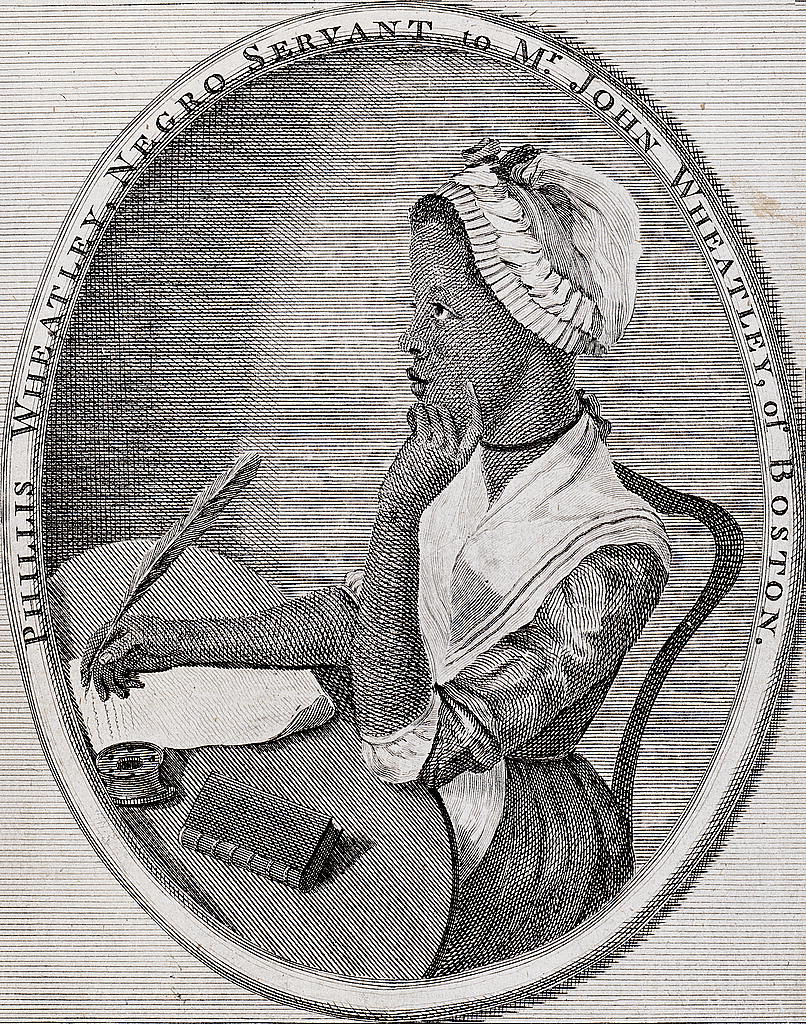
In William Cowper's "The Negro's Complaint," a free white male British citizen mimics the voice of an enslaved African. In Phillis Wheatley's "On Being Brought from Africa to America" an enslaved black woman writes of her own experience.
What differences can you identify in the way these two poems represent slavery? Are any of those differences particularly telling about the different situations of these two writers?
Deadline: Friday (4/3), 10am.


2 comments:
I think that one of the more interesting differences in representing slavery for these poems is that Cowper, a white male, was probably able to write more harshly about slavery than a black woman who actually experienced it. He did not have to worry about an editor censoring what he wrote or even preventing what he wanted to publish.The use of religion also differs between the two poems, with Cowper using it as a tool to question slavery writing "Has He bid you buy and sell us, Speaking from his throne, the sky?" He is more critical about religious justifications of slavery than Wheatley seems to be. She writes about "mercy," "redemption," and becoming "refin'd," looking at her abduction from her native land as a blessing of sorts that brought her to religious understanding. As mentioned in class, she may be using a sarcastic tone in her poem, but if you read the last two lines of the poem ("Remember, Christians, Negroes, black as Cain, May be refin'd and join th' angelic train.") as an address to white Christians rather than a list I think it is difficult to overlook religion as somewhat of a justification of slavery.
I agree with Caitlin, I think that it is interesting that Cowper is more free in his writing than Wheatley. He did not have nearly as much social pressure and restrictions as Wheatley faced as the first published African American writer. However, I would argue that Cowper's poem reads like a white man writing through what he believes to be a Black perspective. There is this sentiment as in the poem we read discussing the dying Indian, that the enslaved other is furious and raging at his captor. While this is true it seems as though in both cases both authors tried almost too hard to get this message of indignation across. So that it seems so exaggerated that the reader will not be able to respond to the story. This approach will not move them to want to act because they see that the colonized peoples are outraged by this treatment. People respond to people and so it seems as though Wheatley is trying very hard to demonstrate how humble and human African Americans are. She mentions the mercy that saved her benighted soul and she reminds the reader that even Blacks can be refined and brought to heaven. Her writing has a very feminine sensitive tone as opposed to Crowley's very masculine and authoritative tone. Wheatley is subtly pushing her message that Blacks should be considered equal and be respected by Whites without doing it such a bold way that it will turn readers off. She recognizes her very precarious place in literary society and so her writing appears to be much more cautious and aware of her audience than Cowper's piece. In contrast Cowper's Pity for the Poor Africans seems to be a much more subtle writing that is very much aware of its audience and their perspective. I find it to be a better abolitionist piece than his Negro's Complaint because he is writing from the perspective of his society. As opposed to trying to write from the slave's point of view which even though he means it in the best way, always seems to end up having that inevitable distance of someone writing about an perspective that they have not experienced directly.
Post a Comment