
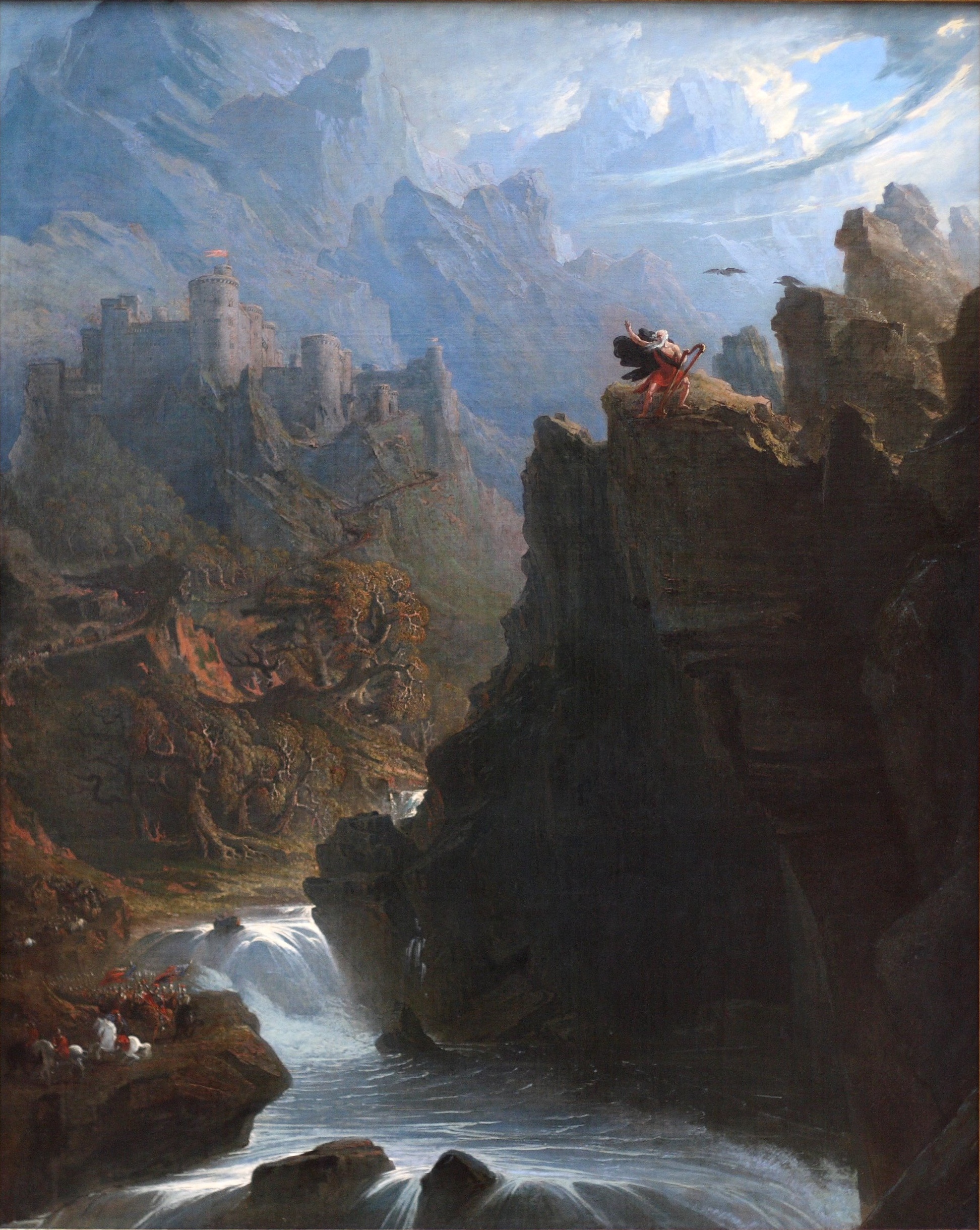
The picture at the left shows The Bard cursing the royal lineage to come, just before he plunges headlong to his death. You might have to squint--he gets lost amidst all the sublime rockery, but he's there.
"The Bard": what you get when you combine the violence and gore of Warton's Dying Indian and Mary Leapor's preoccupation with her poetic vocation with Thomas Gray's desire to jolt his small and learned audience with a startling, original, and deep poem.
Does Gray succeed? Is this a good poem, a historically interesting poem, or further evidence that poetry was a strange and stagnant swamp until the Romantic era poets (Wordsworth, Coleridge, et al.) showed the English-speaking world how to write poems? What is Gray trying to say, and does he succeed in saying it?
Offer your reflections here. Don't be afraid to sound stupid. Don't feel like you have to take on the poem as a whole--a thoughtful comment on a single line or image helps to advance the conversation through which we all achieve understanding.
The footnotes are helpful for this one, but Gray doesn't cut his reader much slack. Just to help you stay oriented in the poem: Edward I conquers Wales in the first stanza; the one bard left standing starts cursing him in the second stanza. The rest of the poem consists of the angry bard airing his grievances, along with the ghosts of the dead bards, who show up at the end of I.3. They predict the history of England to come, including (towards the beginning of II.3) its excellent poets: Spenser, Shakespeare, Milton. Having unburdened himself of the prophecy, the last welsh bard heaves himself off the cliff to join his slaughtered colleagues.
Deadline: Wednesday (2/4), 10am.


3 comments:
This poem was very dramatic but I enjoyed the sublime aspects of it. The way that he likens the British king to a wolf that is devouring all the potential of the country. I was a bit confused at times by the poems and so Prof. Wilcox's footnotes were helpful. But I like the fierce nature of the poem, I think poets like Wordsworth and other Romantics were great. But their poetry doesn't have the fire and defiance that this poetry has, it kind of challenged my whole notion of poetry.
I agree with LaurenH that this poem is definitely more fierce than Wordsworth and his colleagues. I am thinking specifically of how Wordsworth's "Tintern Abbey" compares to "The Bard..." Both poems embrace the sublime, but Gray's poem has more intensity. It actually concerns matters of life and death.
As far as attempting to jolt his audience, I think the Bard's last words do a fairly good job. He cries out that he knows Edward's fate is to rule and despair, and his own fate is to triumph and die, then he goes on to fulfill that fate on his own. It's certainly a striking and moving image to see someone consider that a triumph. I think it aligns with what some people wrote during the first 'inkshedding' exercise about the increasing importance of the individual. The Bard considers his control over his own destiny a greater triumph than the control a tyrant can have over his subjects.
Post a Comment